After staying in Beijing for two and a half days, our stop of a day and a half in Xian seemed like a whirlwind. We began our only full day there with our usual breakfast buffet and a trip to the ATM; unlike in Beijing, we had to cross the street this time. Traffic in Xian was chaotic to say the least -- pedestrians rarely if ever have the right of way, so they simply cross the multi-lane streets whenever they can ease into a gap in traffic. Crossing the street during morning rush hour was like being Frogger (a reference that neither two of my three students nor my colleague knew) -- upon Arnie's advice, we stuck close to a local and darted into traffic as soon as she did. The first two lanes were rather empty when we first stepped out, but the car coming at us in the third lane only slowed down to save himself, I'm sure. We then waited for a moment in the space between the landscaping before traversing the next three lanes flowing in the opposite direction. Somehow we made it without a scratch, and without a panic attack from either me or my kids. On our way back to the hotel from the ATM, we stepped out again with our faith in the local we'd found, and this time one of my girls quickly commented that she thought a nearby bus was moving away from it's parking spot up the block. Without hesitation, I told her we were going to go ahead and run in front of the bus, since it would take a while to gain much speed and reach us, but to watch out for the motorcycles that were weaving in and out of the lanes at increasing speeds. My kids thought it was hilarious, and throughout the rest of the trip, they often reminded me of how I'd encouraged them to run into the street in front of a bus.
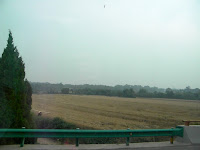 |
| Farmers working |
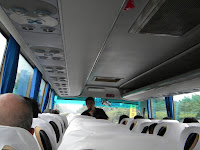 |
| Arnie, giving more information |
We then traveled out of the city, past farmland again, to the Terra Cotta Army Museum. Arnie told us more about the Emperor Qin, who was the first Emperor to unite all of China and who ordered the building of the Terra Cotta warriors and horses to protect him in the afterlife. Qin forced citizens to craft them, demanding that each one look identical to the man creating it and, therefore, be as unique as its creator. If the statue did not meet the Emperor's standards, the man was killed. If a man who worked the kilns made a mistake, he was skinned alive. Just recently, more statues in different poses, many acrobats meant to entertain the Emperor after death, were unearthed.
 |
| Click for full view of Pit 1 from the front door |

 |
| Warriors still being put together |
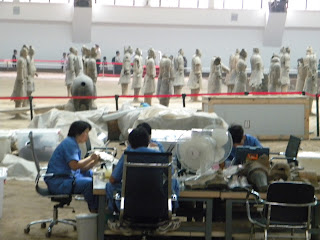 |
| Archeologists piecing together more warriors |

 |
| Archeologists working to unearth more pieces of the puzzle |
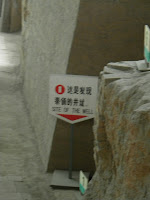 |
| Where the farmers were digging |
Upon Qin's death, the tomb and all of the statues were sealed underground. Not long after Qin died, peasants lead and uprising, and, to show their feelings against Qin's way of ruling the country, they raged through the tomb, destroying the statues. The first piece of a Terra Cotta Warrior was discovered by four farmers in 1974 while attempting to dig a well. At the time, archeologists and government officials thought it was a Buddha head, and because religion was banned in the country then, the farmers were actually sentenced to several years of hard labor for publicly meddling with a religious statue. Later, archeologists began investigating further, and soon they realized they had found the tomb that they had previously only read about in ancient historical documents. Before their discovery, historians had records that described the Terra
Cotta Army, Qin's methods during their creation, and the uprising that
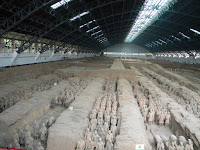
followed; they simply didn't know any of it remained. Today archeologists continue to study over 7,000 larger-than-life statues that they have uncovered in three different Pits, and they are still putting pieces of the statues together. Seeing Pit 1 -- the first and largest area filled with soldiers of all rankings as well as horses for chariots -- was unbelievable. To think that every single statue shows us the likeness of the man who created it blows my mind. It's hard to imagine that each and every one was intricately painted, too; the paint cannot withstand the air once the statue is unearthed, so it peals off and disintegrates. In order to preserve statues that haven't been affected like this, archeologists have an expensive serum developed in Belgium that must be injected into the statues and painted onto them every two years; in further attempts to save them, the statues whose paint is being preserved this way aren't on display. Archeologists have also simply stopped digging in many places to preserve the statues that remain underground until technology is developed to maintain their colorful state.
 |
| Click for full view of Pit 1 |
After spending quite a while in Pit 1, Arnie led our group outside to tell us more about the farmers who discovered the first piece of the Warriors. He said that after the men served their time, the country really didn't think about them any more, and it was actually President Clinton who spurred renewed interest in the men. During his trip to China during his presidency, Clinton visited the Terra Cotta Warriors and asked about the farmers. Arnie said no one had an answer for him, so people started looking for them. Eventually the government located them, and they arranged for President Clinton to meet them. He asked if he could shake their hands and have their autograph; Arnie said that Clinton was surprised to find out that the farmers were illiterate and could not sign their names for him. "They" (whoever that is -- I assume government officials), Arnie said, made sure that the farmers were then taught how to read and write, and President Clinton was later the first person to have all four farmer's autographs. Arnie's telling of this story flowed right into his explanation that we were very lucky -- on that particular day, the only farmer of the four who is still living was at the museum, signing photo books about the Terra Cotta Warriors. For a small price, we could purchase the book, signed by the farmer while we stood there, and a set of post cards. I jumped at the chance to have the man's signature. We were only allowed to take pictures of him if we payed a larger fee, but we were able to watch him sign each of our books individually. Talk about a rare opportunity.
After purchasing the book, we watched a movie describing the history of the Terra Cotta Warriors, most of which Arnie had already told us. The theater was simply a large circular room with upside-down "u" shaped posts for people to lean on during the movie. It was projected all 360 degrees around, sometimes showing different images all around and sometimes showing the same images after 180 degrees.
We then moved on to see Pits 2 and 3, both much smaller and with far less excavated in order to preserve the statues there. A few statues were in display cases near Pit 2, which gave me a better understanding of how large and detailed they are. The soldier's role determined his pose, and they were all taller than many people standing around that day. When looking closely, you can see minute details on their faces, even lines in their hair.
 |
| Intricate details on the statues -- click to see more |


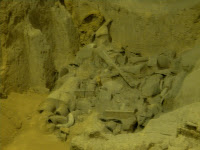 |
| Pieces of statues |
More pieces in Pit 3 remained in their original place, not pieced
together in full statues like in Pit 1. One of my favorite pictures is
of a hand that is simply lying there, apart from the rest of the
statue.
 |
| A hand, as yet unattached |
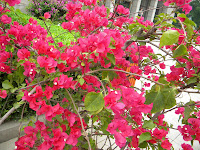 |
| Flowers outside -- does anyone know what kind they are? |
That day we had lunch at a
dumpling restaurant; we had a few appetizers of fried fish, rice, and noodles, and then the
dumplings began to arrive. Waitresses brought out baskets designated by flavor -- pork, chicken, shrimp, mushroom, vegetable, and all types of combinations of all of them -- and each contained one for each of us at the table. Each dumpling was about the size of a flattened golf ball, if not a bit smaller; some were round, others elliptical, and still others just an amoeba-like shape. Most were cream-colored; some veggie ones were green, and the shrimp ones were pink. The waitresses just kept bringing them; we had so many I lost count of them, and despite their small size, no one left hungry. It was a wonderful meal.
Our next stop that afternoon was an art museum, and our tour guide gave us the historical background of the art we saw.
 |
| Farmer Art |
|
 |
| Shadow Art |
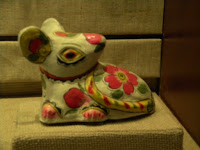 |
| I was born in the year of the Rat |
 |
| Showing ancient symbols |
 |
| The strokes that create current symbols |
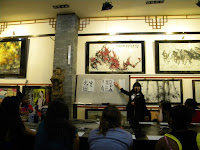
Our guide also gave us a Chinese calligraphy lesson; we learned ancient symbols as well as current ones and were then able to try writing with traditional ink and brushes. We then perused paintings for sale, made by local art students. I bought one with cranes flying across the page.
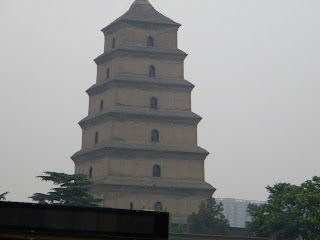
We finished the afternoon at the Big Wild Goose Pagoda. It is a
Buddhist temple, owned and operated by the government. Inside small rooms we saw several types of Buddha statues and places designated for prayer. Arnie told us more about Buddhism, and we witnessed people going about their daily worship as we passed through the monastery. I was able to take
a few outside of the building and the surrounding garden with the
monks' pet birds.


Dinner that night was at a theater; we attended the
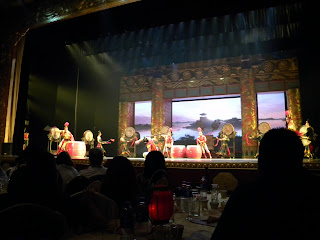
Tang Dynasty Dinner & Show, which serves food and shows performances based on Imperial meals and entertainment during the dynasty that lasted from 618 AD to 907 AD. The menu is listed on the theater's website, linked above; my favorite course was the shrimp and glazed cashews.While we ate our five-course meal and drank our jasmine tea and rice wine, musicians played ancient Chinese instruments. After we finished our Orange Surprise (orange jello with several fruits inside), the show began. Dancers, singers, and instrumentalists performed together in at least a dozen different acts. One man played dozens of bird songs on an intricate flute. Towards the end of the show, the "Emperor and Empress" entered the room and walked down to the stage, joining the performers there and amplifying the imperial feel for the show. I was absolutely delighted when the traditional Chinese dragon dancers arrived; it was the perfect ending to a wonderful performance and a great day in Xian.
 |
| Music during dinner |
|


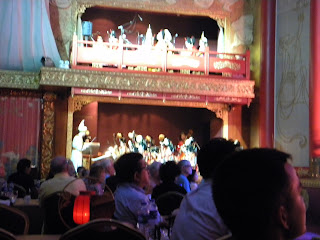 |
| The choir and orchestra |
 |
| The Emperor and Empress |


 We finished the afternoon at the Big Wild Goose Pagoda. It is a
Buddhist temple, owned and operated by the government. Inside small rooms we saw several types of Buddha statues and places designated for prayer. Arnie told us more about Buddhism, and we witnessed people going about their daily worship as we passed through the monastery. I was able to take
a few outside of the building and the surrounding garden with the
monks' pet birds.
We finished the afternoon at the Big Wild Goose Pagoda. It is a
Buddhist temple, owned and operated by the government. Inside small rooms we saw several types of Buddha statues and places designated for prayer. Arnie told us more about Buddhism, and we witnessed people going about their daily worship as we passed through the monastery. I was able to take
a few outside of the building and the surrounding garden with the
monks' pet birds. 


