Over the last week, I read Margaret Atwood's The Handmaid's Tale; I couldn't put it down. My only concern in my hard-to-find moments of free time was whether or not Offred would ever make it out of this terrifying dystopian society, ever find her family and friends from the time before -- before she was reduced to a "womb with legs." Essentially, in the novel North American society has been overtaken by a group who believe only certain people are worthy of the rights and privileges we have today, and those who do not fit into that group are merely used for their services to the so-called greater good, while in reality they're required to serve the same group who decided who qualifies as worthy. In the case of the Handmaids, their only viable service is to use their bodies to propagate.
There's not a lot I can say about the plot without giving too much away, but I can say this -- what a motivation to promote valuing all lives, all people despite differences of opinion. Doesn't it boil down to that? In its simplest form, this is a story of a powerful group refusing to accept, refusing even to tolerate other human beings, reducing them to objects in order to justify using and discarding them. I'm not claiming we should not be passionate about our beliefs, values, morals; I'm insisting that shoving them down others' throats will never convince others to change their minds. Mandating beliefs is an oxymoron.
Addition:
The more I think on the whole novel, the more I think of a passage I want to point out.
Offred said: "But remember that forgiveness too is power. To beg for it is power, and to withhold it or bestow it is a power, perhaps the greatest" (p. 135).
I'm still pondering on just how much and what that means to me; right now it's still brewing in my mind, and I know it's strong. I just don't have words yet for how true that is for me.
Sunday, April 14, 2013


Sunday, April 7, 2013
Surprise Endings
After months of listening to Louise Edrich's The Plague of Doves while working on crocheting projects and reading Jane Eyre by Charlotte Bronte on again and off again, I have to admit both endings surprised me. I tackled both stories rather haphazardly, picking them up and putting them down for something else -- either due to convenience, with the former on audio book, or sheer difficulty moving onward, with the latter. I don't think this approach fostered my prediction skills, but who knows.
Let's start with The Plague of Doves, which I thoroughly enjoyed. As I mentioned in my post about The Round House, Erdrich starts the stories of these characters in Plague, and I have high hopes that these two books aren't the only ones about this particular family. Plague gave many, many smaller stories, and listening to it over several months did make it difficult to piece them all together and see how they were connected. (To my mathematical readers: sometimes it felt like a piecewise function made up of the most random components -- an absolute value grafted onto a cubic curve, grafted yet again onto a logarithmic, all with perfect continuity, and somehow still gracefully approaching infinity in the end. Can you tell I've been working with calculus this spring break?) Sometimes I wasn't sure why we needed to know about a certain person's specific experience, but as always, Louise brought it all together perfectly in the end, showing how each tiny detail played a role in discovering the true murderer from decades past. The interconnectedness of the characters, despite their inability to see it, fascinates me, and it makes me think about how such interconnectedness isn't a fictional characteristic of communities. It's like finding out that someone you've worked with for years knows someone you went to high school with (thank you, Facebook, for indicating mutual friends), except that's happening on a grander scale, and we are as oblivious to it as Erdrich's characters. Side note: I also found it interesting that just after I listened to a character's obsession with Anais Nin, she was described on The Writer's Almanac (where she was quoted as saying, "I write emotional algebra," which I think is cool), and she was mentioned on Bunheads (a tv show -- don't judge). While Nin seems a bit too intense for me to continue to follow, I just liked how so many small areas of my life intertwined for a moment.
And then there is Jane Eyre. And here is where I might make some of my English major friends very unhappy. I really just didn't enjoy it. (*scramble under the desk to avoid being hit with projectile paperweights of a reader or two*) Personally, I've never coped well with romantic novels' explanations of the drawing room's curtains and the like. (Yes, it's true, I didn't like Austen all that much.) I also know that I read such literature through a 2013 feminist's lens, and that's simply not fair. It doesn't change the fact that I do; I just know it affects my perception of the story. I also know that some of my most feminist-driven friends love this book, which means it really is just my personal lens that makes it difficult for me. I didn't connect with Jane, and I was more than perturbed with Rochester for not being up front with her about Bertha before they were in the church. Seriously? I had a hard time letting go of that incident. I'm sure I would have enjoyed analyzing it for reflections of social norms (gender roles, perception of mental illness and poverty, all sorts of things) in a class in undergrad, but I don't think I would've enjoyed reading it to get to that discussion even then. I even watched the movie from 1996 in hopes that seeing it would foster my connection with Jane and Rochester, make me want them to be together forever. It didn't work. Jane -- both Eyre and Austen -- just aren't my cup of tea. (Pun intended.)
With all of that said, I'm left with the great knowledge that it doesn't really matter that I have a huge literary crush on Erdrich and would rather leave Jane Eyre and the like for anyone else but me, even though it seems many, many people I know have the exact opposite opinions. (No one I've recommended Erdrich to has enjoyed her the way I do. No one. I even just found out that the professor who introduced me to Erdrich doesn't like her that much. Talk about a downer.) What matters is that I know what I like, and I try other pieces every now and again, and other people know what they like, and they try other pieces every now and again, too. So, take my opinions or leave them; I'm off to read another book from during or after the Modernist movement.
Let's start with The Plague of Doves, which I thoroughly enjoyed. As I mentioned in my post about The Round House, Erdrich starts the stories of these characters in Plague, and I have high hopes that these two books aren't the only ones about this particular family. Plague gave many, many smaller stories, and listening to it over several months did make it difficult to piece them all together and see how they were connected. (To my mathematical readers: sometimes it felt like a piecewise function made up of the most random components -- an absolute value grafted onto a cubic curve, grafted yet again onto a logarithmic, all with perfect continuity, and somehow still gracefully approaching infinity in the end. Can you tell I've been working with calculus this spring break?) Sometimes I wasn't sure why we needed to know about a certain person's specific experience, but as always, Louise brought it all together perfectly in the end, showing how each tiny detail played a role in discovering the true murderer from decades past. The interconnectedness of the characters, despite their inability to see it, fascinates me, and it makes me think about how such interconnectedness isn't a fictional characteristic of communities. It's like finding out that someone you've worked with for years knows someone you went to high school with (thank you, Facebook, for indicating mutual friends), except that's happening on a grander scale, and we are as oblivious to it as Erdrich's characters. Side note: I also found it interesting that just after I listened to a character's obsession with Anais Nin, she was described on The Writer's Almanac (where she was quoted as saying, "I write emotional algebra," which I think is cool), and she was mentioned on Bunheads (a tv show -- don't judge). While Nin seems a bit too intense for me to continue to follow, I just liked how so many small areas of my life intertwined for a moment.
And then there is Jane Eyre. And here is where I might make some of my English major friends very unhappy. I really just didn't enjoy it. (*scramble under the desk to avoid being hit with projectile paperweights of a reader or two*) Personally, I've never coped well with romantic novels' explanations of the drawing room's curtains and the like. (Yes, it's true, I didn't like Austen all that much.) I also know that I read such literature through a 2013 feminist's lens, and that's simply not fair. It doesn't change the fact that I do; I just know it affects my perception of the story. I also know that some of my most feminist-driven friends love this book, which means it really is just my personal lens that makes it difficult for me. I didn't connect with Jane, and I was more than perturbed with Rochester for not being up front with her about Bertha before they were in the church. Seriously? I had a hard time letting go of that incident. I'm sure I would have enjoyed analyzing it for reflections of social norms (gender roles, perception of mental illness and poverty, all sorts of things) in a class in undergrad, but I don't think I would've enjoyed reading it to get to that discussion even then. I even watched the movie from 1996 in hopes that seeing it would foster my connection with Jane and Rochester, make me want them to be together forever. It didn't work. Jane -- both Eyre and Austen -- just aren't my cup of tea. (Pun intended.)
With all of that said, I'm left with the great knowledge that it doesn't really matter that I have a huge literary crush on Erdrich and would rather leave Jane Eyre and the like for anyone else but me, even though it seems many, many people I know have the exact opposite opinions. (No one I've recommended Erdrich to has enjoyed her the way I do. No one. I even just found out that the professor who introduced me to Erdrich doesn't like her that much. Talk about a downer.) What matters is that I know what I like, and I try other pieces every now and again, and other people know what they like, and they try other pieces every now and again, too. So, take my opinions or leave them; I'm off to read another book from during or after the Modernist movement.
Sunday, February 10, 2013
To another world...
In a mere week, I completed Louise Erdrich's The Round House, and now I find myself missing some of the characters. Wondering what happens next. How Joe fares after the final trauma of the novel. The moment I began reading the book, I fell into the world that Erdrich created, this time recognizing characters from The Plague of Doves and even a few names here and there from her earlier novels. That's how she always hooks me -- she plays on my desire to see how everyone ends up after the last page of the last book I read, how everyone becomes even more intertwined than before. Perhaps it's my small town heritage that feeds this desire; perhaps I just like maintaining the friendships she fosters. Regardless of why, I have a desperate hope that Louise someday tells us more about Joe and Margaret. About Geraldine and Bazil.
The novel is undoubtedly Joe's coming of age story, a story of how a summer that really wasn't about him at all became the most defining months of his life. It is about his mother and, more importantly, his family as a whole. The string of violence and trauma that Joe's family endures is horrendous, but his family shows how strong we can be in the face of such atrocities. How we can make some sense of complete and utter nonsense, and cope with the lingering nonsense that is never resolved. How we justify our actions, yearn for justice, for peace. How we want back what we knew before, and how we cope with knowing that nothing will ever be that way again. Coping, even transforming through coping -- both are vital threads of the story.
Between the award Erdrich has received for the book and its themes of gender, native, and justice issues, I foresee professors including this book in their syllabi soon. I hope this happens, at least -- it has the potential to open serious discussions about rape, tribal and non-tribal politics, justice, morals, religion, and the basic process of uncovering one's identity. I could only imagine the classroom discussions we could have when Joe and Cappy find themselves asking one another, "What are we?...What are we now?" Comparing their struggling, shaky sense of identity to Linda's strong understanding of who she is, despite her convoluted history. This is why I hope someday Louise writes more about Joe's life -- to find out just what he becomes, who he becomes, what good he does in the world. Whether or not Father Travis was right, that God does "draw good from any evil situation," even the evil that seemed to compound in Joe's life up until the final pages of the book.
If you love Erdrich and the world she has created, you'll love The Round House, too. If you don't know her yet, this would be an excellent way to get to know her, and then I highly recommend reading more of her works to see how all of these people are connected.
The novel is undoubtedly Joe's coming of age story, a story of how a summer that really wasn't about him at all became the most defining months of his life. It is about his mother and, more importantly, his family as a whole. The string of violence and trauma that Joe's family endures is horrendous, but his family shows how strong we can be in the face of such atrocities. How we can make some sense of complete and utter nonsense, and cope with the lingering nonsense that is never resolved. How we justify our actions, yearn for justice, for peace. How we want back what we knew before, and how we cope with knowing that nothing will ever be that way again. Coping, even transforming through coping -- both are vital threads of the story.
Between the award Erdrich has received for the book and its themes of gender, native, and justice issues, I foresee professors including this book in their syllabi soon. I hope this happens, at least -- it has the potential to open serious discussions about rape, tribal and non-tribal politics, justice, morals, religion, and the basic process of uncovering one's identity. I could only imagine the classroom discussions we could have when Joe and Cappy find themselves asking one another, "What are we?...What are we now?" Comparing their struggling, shaky sense of identity to Linda's strong understanding of who she is, despite her convoluted history. This is why I hope someday Louise writes more about Joe's life -- to find out just what he becomes, who he becomes, what good he does in the world. Whether or not Father Travis was right, that God does "draw good from any evil situation," even the evil that seemed to compound in Joe's life up until the final pages of the book.
If you love Erdrich and the world she has created, you'll love The Round House, too. If you don't know her yet, this would be an excellent way to get to know her, and then I highly recommend reading more of her works to see how all of these people are connected.
Sunday, December 30, 2012
A Semester's Worth of Reading
This semester has been a busy one, so there's been very little reading for fun going on around here. For my class, I read pieces of (insert shudder here -- wouldn't a professor know the importance of reading an entire piece, in the right order no less, to know the full context?) of Malcolm Gladwell's The Tipping Point as well as Millennials Rising: The Next Generation by Howe and Strauss. The former was interesting but difficult at times to apply to an educational setting; the latter was published in 2001, before we could even imagine how the colossal influences of September 11 and Facebook would impact our students and the way they learn. Alas, these texts did little to further my understanding of how to best foster learning in my classroom. Thankfully, I was also responsible for reading and implementing ideas on formative assessment, which was helpful and stands to create great change in education if handled well.
With that aside, I did read a bit during what little time I had leftover. First I started with the amazing Half the Sky by Nicholas D. Kristof and Sheryl WuDunn, nonfiction authors who are a major part of the movement for educating women worldwide. I had heard my college friends and former professors talking about it, raving about it, telling how it moved them to action, for quite some time. Then I heard WuDunn speak at The Global Leadership Summit last August, at which she read excerpts of their book. As I sat in the audience, tears streaming down my face as she told us how a fundamental education had changed the lives of women they'd met, I knew I'd need to buy the book to know more about their mission. I'll admit I haven't finished the book yet (I can hear boos and hisses as I type), but I think that's merely because I'm not well trained or self-disciplined when it comes to reading non-fiction. I am sadly addicted to the plot diagram we learned about in middle school, and nonfiction simply doesn't work that way. I'm nearly finished, though, and it has moved me to action -- I've revisited the ways I can promote education in Liberia through much-needed scholarships for students and improving teacher education programs in the country. The authors discuss other ways to "[turn] oppression into opportunity for women worldwide" as well, but being an educator, that part stays with me and is more meaningful. As I read story after story of women whose education changed their lives, I was reminded why I do what I do -- no matter who the students are, where they are, or the social norms they must face, an education can help them create a better future for all of us.
Feeling a bit guilty that I hadn't yet finished Half the Sky, I felt it important that I maintain the theme a bit and moved to A Short History of Women by Kate Walbert. It comes highly acclaimed, and I enjoyed it enough to finish it, but I was sadly never lost in it. The premise is brilliant: the novel follows five generations of women in the Townsend family, beginning with an early feminist Dorothy in England and working through trials and tribulations until the Millennial Dora. The set-up is right up my alley: multiple narrators, a non-linear pacing to help us see how specific events influence later ones. When it came right down to it, though, I continued reading it simply because I thought somehow, eventually, I would truly connect with a character. It never happened. I think Walbert simply took the plight of women in a direction with which I could not align myself -- she did not include a single lasting joy for any of the five women. Having read many feminist pieces in college and after, I am well aware of the plight Walbert was focusing upon; even so, her laser-like focus on how none of these women found meaning, solace, or joy in anything was merely depressing. It's not like, for instance, Kate Chopin's The Awakening. Edna's story is devastating, but telling it has purpose. And when Edna makes her final decision, it made me what to go out and do something, something important, something that would make me feel complete, feel like an important cog in this big mess of a machine. It's ironic, really, that this book did not spark that kind of drive within me, since Dorothy Townsend Barrett, the third generation of the family, screamed, "DO SOMETHING," from every rooftop she could find. Perhaps the call meant so little to me because none of the women actually did anything, except for maybe the first Dorothy, more than merely talk about how they weren't doing what they truly wanted to do.
Without even realizing it, I then continued the theme of women's situations with Nancy Horan's Loving Frank, which I completed in a mere four days. Now, Mamah Borthwick (Cheney) -- now she is a character I connected with, one I felt was telling me her story as we sat together on my living room sofa. Mamah was the lover of Frank Lloyd Wright from around 1903 to 1914. I first bought the book after touring Wright's Dana Thomas House and thought I'd like to know more about the architect. Having the Dana Thomas house in mind, I was intrigued by Horan's take on Wright's motivation; I especially liked an early description of how he incorporated the horizon into his pieces -- I yearn to live in a place where I can see a section of horizon from my windows. I am also intrigued by his thoughts that, "what you put into [a] space will affect how you live in it and what you become" (p. 232). Although I do now understand Wright more than before reading the book, it really wasn't about him. It was about Mamah.
Mamah struggled with the expectations of women that Walbert addressed; Mamah found her place despite a society of norms that pushed her in another direction. She looked for a way to live out her own identity, to Memento vivere -- remember to live -- on her own terms, and she encouraged others to as well. She was far from popular in having this long-term affair with Frank, with those closest to her as well as the entire Midwest, but after years of searching substance and meaning, she was a better person, and popularity was far from important. The feminist movement -- painted by Horan as primarily for suffrage and equal pay here in the States but also about individual freedom in other countries as well -- was in the forefront of both Mamah's and Frank's minds and of the story. And story it is...it's a fictionalized account of their meeting, their relationship, their life together. Very little documentation on Mamah exists, but Horan did a wonderful job giving what she felt is Mamah's point of view from the few facts we have. I can't say much else, so as not to give anything away, but know that it is a brilliant work that make me wish I wasn't at the end.
With that aside, I did read a bit during what little time I had leftover. First I started with the amazing Half the Sky by Nicholas D. Kristof and Sheryl WuDunn, nonfiction authors who are a major part of the movement for educating women worldwide. I had heard my college friends and former professors talking about it, raving about it, telling how it moved them to action, for quite some time. Then I heard WuDunn speak at The Global Leadership Summit last August, at which she read excerpts of their book. As I sat in the audience, tears streaming down my face as she told us how a fundamental education had changed the lives of women they'd met, I knew I'd need to buy the book to know more about their mission. I'll admit I haven't finished the book yet (I can hear boos and hisses as I type), but I think that's merely because I'm not well trained or self-disciplined when it comes to reading non-fiction. I am sadly addicted to the plot diagram we learned about in middle school, and nonfiction simply doesn't work that way. I'm nearly finished, though, and it has moved me to action -- I've revisited the ways I can promote education in Liberia through much-needed scholarships for students and improving teacher education programs in the country. The authors discuss other ways to "[turn] oppression into opportunity for women worldwide" as well, but being an educator, that part stays with me and is more meaningful. As I read story after story of women whose education changed their lives, I was reminded why I do what I do -- no matter who the students are, where they are, or the social norms they must face, an education can help them create a better future for all of us.
Feeling a bit guilty that I hadn't yet finished Half the Sky, I felt it important that I maintain the theme a bit and moved to A Short History of Women by Kate Walbert. It comes highly acclaimed, and I enjoyed it enough to finish it, but I was sadly never lost in it. The premise is brilliant: the novel follows five generations of women in the Townsend family, beginning with an early feminist Dorothy in England and working through trials and tribulations until the Millennial Dora. The set-up is right up my alley: multiple narrators, a non-linear pacing to help us see how specific events influence later ones. When it came right down to it, though, I continued reading it simply because I thought somehow, eventually, I would truly connect with a character. It never happened. I think Walbert simply took the plight of women in a direction with which I could not align myself -- she did not include a single lasting joy for any of the five women. Having read many feminist pieces in college and after, I am well aware of the plight Walbert was focusing upon; even so, her laser-like focus on how none of these women found meaning, solace, or joy in anything was merely depressing. It's not like, for instance, Kate Chopin's The Awakening. Edna's story is devastating, but telling it has purpose. And when Edna makes her final decision, it made me what to go out and do something, something important, something that would make me feel complete, feel like an important cog in this big mess of a machine. It's ironic, really, that this book did not spark that kind of drive within me, since Dorothy Townsend Barrett, the third generation of the family, screamed, "DO SOMETHING," from every rooftop she could find. Perhaps the call meant so little to me because none of the women actually did anything, except for maybe the first Dorothy, more than merely talk about how they weren't doing what they truly wanted to do.
Without even realizing it, I then continued the theme of women's situations with Nancy Horan's Loving Frank, which I completed in a mere four days. Now, Mamah Borthwick (Cheney) -- now she is a character I connected with, one I felt was telling me her story as we sat together on my living room sofa. Mamah was the lover of Frank Lloyd Wright from around 1903 to 1914. I first bought the book after touring Wright's Dana Thomas House and thought I'd like to know more about the architect. Having the Dana Thomas house in mind, I was intrigued by Horan's take on Wright's motivation; I especially liked an early description of how he incorporated the horizon into his pieces -- I yearn to live in a place where I can see a section of horizon from my windows. I am also intrigued by his thoughts that, "what you put into [a] space will affect how you live in it and what you become" (p. 232). Although I do now understand Wright more than before reading the book, it really wasn't about him. It was about Mamah.
Mamah struggled with the expectations of women that Walbert addressed; Mamah found her place despite a society of norms that pushed her in another direction. She looked for a way to live out her own identity, to Memento vivere -- remember to live -- on her own terms, and she encouraged others to as well. She was far from popular in having this long-term affair with Frank, with those closest to her as well as the entire Midwest, but after years of searching substance and meaning, she was a better person, and popularity was far from important. The feminist movement -- painted by Horan as primarily for suffrage and equal pay here in the States but also about individual freedom in other countries as well -- was in the forefront of both Mamah's and Frank's minds and of the story. And story it is...it's a fictionalized account of their meeting, their relationship, their life together. Very little documentation on Mamah exists, but Horan did a wonderful job giving what she felt is Mamah's point of view from the few facts we have. I can't say much else, so as not to give anything away, but know that it is a brilliant work that make me wish I wasn't at the end.
Saturday, August 11, 2012
Gatsby and gods; Taylor and Turtle
I'll admit it -- I'm rather proud of myself for reading three books this summer among the travel, classes, and writing I've been up to.
I began Jane Eyre while in the airports on the China trip, but I just couldn't seem to read it while poolside once I returned home...far too many distractions, and it was simply too hot. One must get to know Jane, I think, when snow is blowing outside.
Gatsby, Nick, Daisy, and the rest, though -- I could read about them on the hottest of days. Their passions, shallow though many of them are, run as hot as passions can. I first read The Great Gatsby in my high school junior English class, and I remember standing in awe of it. After seeing previews of the new Gatsby movie coming out this December, I knew I needed to reread it to prepare myself. To remind myself. To see if I still fell into it the way I remembered I did so many years ago.
I did. I couldn't put it down.
As I told friends that I was rereading it, a handful threw their hands in the air, rolled their eyes, and exclaimed, "Ugh, I hated Gatsby!" I have no desire to hear about the problems of the rich." I kid you not, every one of them who insisted that Fitzgerald's work is atrocious sited the lack of relevancy in their lives based on financial differences. And yet, when I read it this time, I could see nothing but connections between these people and my generation. They wanted it all, and they thought all of it, together, collectively, would make their lives complete. Happy. Full. But the more they stacked up, the more they accumulated -- money, houses, furniture, clothes, cars, drinks, people -- the faster the significance of it all diminished. As a mathematician, I see it as inversely proportional: as one increases, the other decreases, and vice-verse. All of this could be plucked out of the 1920s and dropped anywhere in 2012, and it would fit in as snugly as if it had always been there. These are not only the distorted dreams of the Roaring Twenty's wealthy; they are the distorted dreams of so many people today, wealthy or not. Money is not a prerequisite of being materialistic or delusional. This theme hasn't left our culture in the last 90+ years -- it's still running rampant through tv, movies, books, and magazines, so it must still resonate with someone. Don't get me wrong; I don't like the Buchanans and their lot. I agree with Nick that they were "a rotten crowd," and I felt he summed them up well toward the end of the book:
"It was all very careless and confused. They were careless people, Tom and Daisy -- they smashed up things and creatures and then retreated back into their money or their vast carelessness or whatever it was that kept them together, and let other people clean up the mess they had made..."
If this doesn't remind you of people in our era, then I'm happy for you. But because we're clearly still seeing signs of this mindset in our society today, regardless of just how much money the people in question have, I maintain that Gatsby is still a relevant read.
Gatsby, I think, was a non-traditional materialist: he didn't think all the riches would bring him happiness, but he did think they'd bring him Daisy and, therefore, happiness. He was right on the money (bu dum ching!) when it came to Daisy's skewed priorities, but he didn't realize that those same priorities also skewed her love for him. He admitted at one point that "[h]er voice is full of money;" he simply didn't know it was so full that there was no longer space for him. Gatsby was certain he could "repeat the past," another theme that still fills our culture, by showing Daisy he was even more grand than when they first met. I think his obsession with the past is stronger than his actual love for Daisy; he's mixed up the two, or somehow identified them as the same. Fitzgerald makes it clear that we can't live as if time moving forward doesn't change the people and the world around us, and yet he ends the book by reminding us that we also can't live without the past affecting us.
"...tomorrow we will run faster, stretch our our arms farther...And one fine morning --
So we beat on, boats against the current, borne back ceaselessly into the past."
And finally: the green light, because that's quintessentially Gatsby for so many readers. For a while -- I don't know how long -- I had forgotten how blatant Fitzgerald was about the connection between the green light and Daisy. I only remembered that we discussed it in class, and I often wondered if that was one of the great symbols of literature pointed out in class discussions that I never actually identified in textual evidence myself...but to my pleasant surprise, Fitzgerald really spelled out the whole idea for us. Now I see why so many teachers use it to foster understanding of symbols and figurative language.
So if you haven't read it since high school, or heaven forbid you never read it at all, pick it up immediately. It's short, but it holds a massive impact. Then join me when the movie comes out in December.
I began Jane Eyre while in the airports on the China trip, but I just couldn't seem to read it while poolside once I returned home...far too many distractions, and it was simply too hot. One must get to know Jane, I think, when snow is blowing outside.
Gatsby, Nick, Daisy, and the rest, though -- I could read about them on the hottest of days. Their passions, shallow though many of them are, run as hot as passions can. I first read The Great Gatsby in my high school junior English class, and I remember standing in awe of it. After seeing previews of the new Gatsby movie coming out this December, I knew I needed to reread it to prepare myself. To remind myself. To see if I still fell into it the way I remembered I did so many years ago.
I did. I couldn't put it down.
As I told friends that I was rereading it, a handful threw their hands in the air, rolled their eyes, and exclaimed, "Ugh, I hated Gatsby!" I have no desire to hear about the problems of the rich." I kid you not, every one of them who insisted that Fitzgerald's work is atrocious sited the lack of relevancy in their lives based on financial differences. And yet, when I read it this time, I could see nothing but connections between these people and my generation. They wanted it all, and they thought all of it, together, collectively, would make their lives complete. Happy. Full. But the more they stacked up, the more they accumulated -- money, houses, furniture, clothes, cars, drinks, people -- the faster the significance of it all diminished. As a mathematician, I see it as inversely proportional: as one increases, the other decreases, and vice-verse. All of this could be plucked out of the 1920s and dropped anywhere in 2012, and it would fit in as snugly as if it had always been there. These are not only the distorted dreams of the Roaring Twenty's wealthy; they are the distorted dreams of so many people today, wealthy or not. Money is not a prerequisite of being materialistic or delusional. This theme hasn't left our culture in the last 90+ years -- it's still running rampant through tv, movies, books, and magazines, so it must still resonate with someone. Don't get me wrong; I don't like the Buchanans and their lot. I agree with Nick that they were "a rotten crowd," and I felt he summed them up well toward the end of the book:
"It was all very careless and confused. They were careless people, Tom and Daisy -- they smashed up things and creatures and then retreated back into their money or their vast carelessness or whatever it was that kept them together, and let other people clean up the mess they had made..."
If this doesn't remind you of people in our era, then I'm happy for you. But because we're clearly still seeing signs of this mindset in our society today, regardless of just how much money the people in question have, I maintain that Gatsby is still a relevant read.
Gatsby, I think, was a non-traditional materialist: he didn't think all the riches would bring him happiness, but he did think they'd bring him Daisy and, therefore, happiness. He was right on the money (bu dum ching!) when it came to Daisy's skewed priorities, but he didn't realize that those same priorities also skewed her love for him. He admitted at one point that "[h]er voice is full of money;" he simply didn't know it was so full that there was no longer space for him. Gatsby was certain he could "repeat the past," another theme that still fills our culture, by showing Daisy he was even more grand than when they first met. I think his obsession with the past is stronger than his actual love for Daisy; he's mixed up the two, or somehow identified them as the same. Fitzgerald makes it clear that we can't live as if time moving forward doesn't change the people and the world around us, and yet he ends the book by reminding us that we also can't live without the past affecting us.
"...tomorrow we will run faster, stretch our our arms farther...And one fine morning --
So we beat on, boats against the current, borne back ceaselessly into the past."
And finally: the green light, because that's quintessentially Gatsby for so many readers. For a while -- I don't know how long -- I had forgotten how blatant Fitzgerald was about the connection between the green light and Daisy. I only remembered that we discussed it in class, and I often wondered if that was one of the great symbols of literature pointed out in class discussions that I never actually identified in textual evidence myself...but to my pleasant surprise, Fitzgerald really spelled out the whole idea for us. Now I see why so many teachers use it to foster understanding of symbols and figurative language.
So if you haven't read it since high school, or heaven forbid you never read it at all, pick it up immediately. It's short, but it holds a massive impact. Then join me when the movie comes out in December.
***
Next, I jumped into a more modern book, with far more ancient characters. I read American Gods by Neil Gaiman, which follows the story of Shadow and his journey and battles with the gods who traveled to America as immigrants along with their immigrant believers. I thoroughly enjoyed learning more about different culture's religions, myths, and heroes -- which, according to Gaiman, aren't all the same -- and it always makes me feel intelligent when I understand references to other pieces of literature and art speckled throughout. I feel like I can't share with you much about the plot for fear that I will give too much away; the most minute of details could give you a hint that would ruin the many surprises that unfold as the story moves forward. It wasn't the easiest of reads, though, because of the tangents the story took through certain sections and chapters. I think Gaiman wanted to flesh out the whole idea of multiple gods making their way here, staying with their people as long as they believed in them, but I have a hard time caring about characters who aren't really a part of the plot line. I did enjoy the tangents, though, that described rural Illinois as Shadow drove from Chicago to Cairo ("they call that one Kayro") -- the Culver's fast food restaurant, each tiny town's population sign standing right next to their high school athletic claim to fame. And I liked the rants that Sam, an unexpected friend of Shadow's, provided on all the stuff that we believe in this society, both good and bad, both reasonable and illogical. I recommend it if you like stories with twists, and especially if you like mythology (even if it's just what you've learned from Marvel comics and movies).
***
Most recently, I read Barbra Kingsolver's The Bean Trees, which is unlike any book I've ever read. I choose it for a couple reasons -- I loved her novel The Poisonwood Bible (which I read in high school and was my introduction to literature with multiple narrators), the main character changes her name after traveling through my corner of the world, and a friend of mine from work is also reading it right now. Kingsolver didn't let me down.
The novel follows Taylor in the 1980s as she strikes out on her own, moving from her hometown in Kentucky across the Great Plains and the dessert and finally settling in Tuscon. On her journey, she unexpectedly becomes the guardian of a special little girl named Turtle, and the story focuses on how Taylor grows into this new role.
Taylor is a force to be reckoned with. She leads by example and convinces her new friends in Tuscon that if the world is to improve, we cannot be complacent. "What I'm saying is," she says, "you can't just sit there, you got to get pissed off." She doesn't face the evils of the world as a some super hero, though; she battles frustration and hopelessness just like the rest of us. "Sadness," she says, "is more or less like a head cold -- with patience it passes. Depression is like cancer." But in the end, Taylor's determination to do what she can to improve the lives of those she loves breaks through, and she does remarkable deeds in the face of great risk.
Woven in among the plot and inspiration, Kingsolver made me smile to myself as I connected with some of Taylor's experiences. Not only did she pass through towns I know early on in her journey, but she also spoke in a dialect that made me feel right at home. She even quoted little sayings that I've heard a million times in my parents' and grandparents' homes but had never seen in print before. Like some of my friends who'd rather not live in a place where you can see the horizon countless miles away (which my friends know is something I love), Taylor also developed an intense distaste for the Great Plains and all flat ground:
"The sight of it filled me with despair...I had never imagined that any part of a round earth could be so flat. In Kentucky you could never see too far, since there were always mountains blocking the other side of your view, and it left you the chance to think something good might be just over the next hill. But out there on the plain it was all laid out right in front of you, and no matter how far you looked it didn't get any better."
"I believe that flat places are quieter than hilly ones. The sounds of the cars on the highway seemed to get sucked straight out over the empty fields where there was nothing, not even a silo, to stop them from barreling on forever into the night."
Taylor and Turtle even live with a roommate and her son, which is somewhat similar to my situation. Some of their escapades sounded all too familiar, and the friendship that develops between them undoubtedly did.
Without hesitation, I recommend The Bean Trees, and The Poisonwood Bible as well. Kingsolver is an excellent story teller and has a wonderfully unique way with words.
Thursday, July 26, 2012
Chinese Adventure! Final Installment: Shanghai

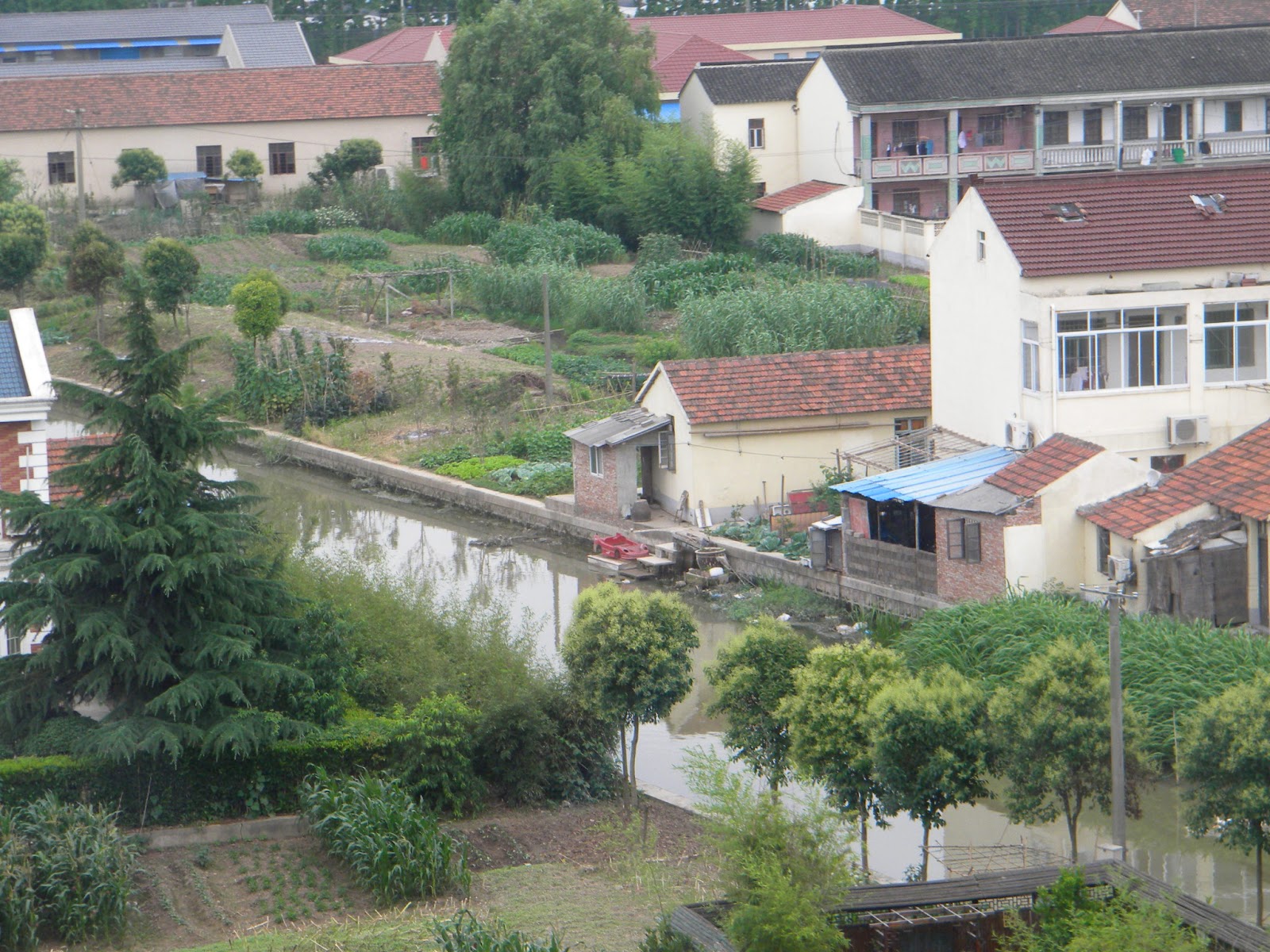
 Our last city on our tour of China was Shanghai, and we spent about a day and a half there. Driving into the city was awesome -- even the poorest areas didn't appear very poor at all. Everywhere more skyscrapers were popping up before our eyes, and Yoko told us that wasn't much of an exaggeration; most of the city was built up from rice patties in the last twenty years.

 |
| Bottle Opener from the ground |

Our first stop was the World Financial Center, also known as the Bottle Opener. It's the second tallest building in the world, measuring an impressive 492 meters high, and we traveled to the 100th floor (out of 101) for a bird's eye view of Shanghai. We began in a room with 5 or 6 feet tall digital numbers on the ceiling, counting down something that we were never informed of.

 Next we traveled 435 meters high in a large elevator with a light show
that made me wonder if we were being brainwashed.
Next we traveled 435 meters high in a large elevator with a light show
that made me wonder if we were being brainwashed. 
We then took a very steep escalator up to a stark white floor (where I expected to see a mad scientist walk out in an equally-white lab coat) whose only apparent purpose was to hold tourists waiting to take the next elevator, smaller this time, to our final destination. The 100th floor is 474 meters high and is made completely of glass, giving an excellent view of the city and miles (and miles) beyond.

 Looking out at the city made me feel like we were playing Monopoly -- huge sections of building, what appeared to me like apartment complexes, looked identical from the sky, and it felt like we should be able to pick them up and move them to Boardwalk to win the whole game. We could see how the city has grown up around the rivers, and how the skyscrapers have taken over a large portion of the riverbank. Because the floor is made of glass, we could also see straight down; the 100th floor sits right on top of the "bottle opener" opening, so we had an excellent view of the streets and buildings right below us.
  |
| Click for full view |
 |
| Looking through the floor |

 |
| Click for full view |
 |
| My favorite picture from the Bottle Opener |
 |
| Monopoly Time! |
 My favorite picture was one I took as a reflection. The ceiling had an
excellent reflection, so I was able to get a picture of me (taking the
picture, at the bottom of the frame) and the buildings behind/below us.
My favorite picture was one I took as a reflection. The ceiling had an
excellent reflection, so I was able to get a picture of me (taking the
picture, at the bottom of the frame) and the buildings behind/below us.  | |
| A TV Station |


 |
| Click for full view |


Shanghai seemed much more influenced by Western countries, which makes sense considering its history with both import and export trade. We saw many more signs of home, including 7 Eleven and the YMCA.

 As the daughter of a retired Department of Transportation employee, I was very impressed with their highway system. In some places, there were 5 levels of highway stacked on top of each other.
  |
| Karaoke! |
That afternoon, we spent a bit of time at a local karaoke; it was very different than karaoke here at home. We rented the entire room, complete with the microphones and TV showing the music videos and lyrics. We had quite the time, and my kids were quite surprised by the number of songs I knew, too.


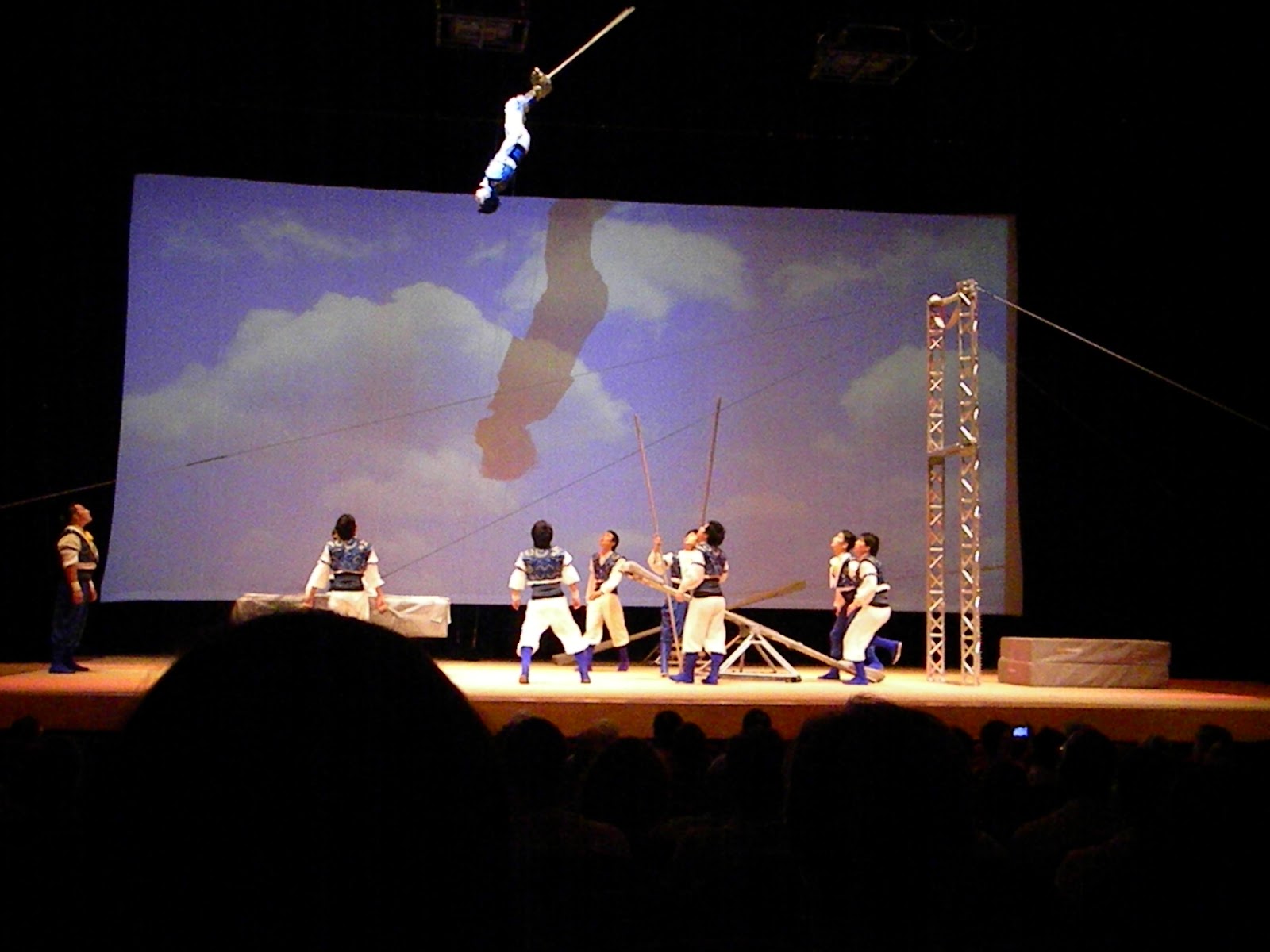
After another traditional dinner on the lazy susan, we attended the Shanghai Acrobatics Performance. The acrobats were amazing -- some balanced items, others balanced themselves; some threw items, others were thrown. Some were even contortionists, and they were able to create images that none of us could believe were actually happening.


The next day -- our final day in China -- held only a few sites for us but much shopping. First we visited the Jade Buddha Temple, where we took in the beautiful art and witnessed more people practicing their faith.
 |
| View from the Temple |

 |
| One of the Temple buildings |
 |
| Silkworms |
We then took a tour of a silk factory, where we watched women carefully separating silkworm cocoons and weaving them together to create strands and, in the end, beautiful pillows, blankets, handkerchiefs, and more.


 |
| Nan Jing Road |
 |
| Seafood bowl & "Green" Tea |


 Our next stop was the Yuyuan Garden, created by a government official
for his parents over 450 years ago. The architecture is beautiful; the
fish ponds and landscaping are absolutely tranquil. Once inside, one
might never guess she is smack dab in the middle of one of the most
populated cities in the world.
Our next stop was the Yuyuan Garden, created by a government official
for his parents over 450 years ago. The architecture is beautiful; the
fish ponds and landscaping are absolutely tranquil. Once inside, one
might never guess she is smack dab in the middle of one of the most
populated cities in the world.  |
| Dragon Statue |
 |
| The Yuyuan Market |
The three of us ended our trip to the Bazaar with a purchase at the Dairy Queen; I had a chocolate dipped ice cream cone. Now, I've found that telling some people back here at home this detail just produces a look that says, "You went all the way to Shanghai and ate at a DQ?" My response is this: YES! You see, having grown up in SmallTown, USA, Dairy Queen was the only fast food restaurant in my hometown until about the year 2000. To be able to go from that SmallTown and travel to the other side of the world and have the same chocolate dipped cone that I once had as a 7 year old -- it represents so much. On one hand, it was a cheesy connection, a way of saying that some things transcend cultural boundaries and the Pacific. But on the other, it was a sign of how far I've come; the 7-year-old me would have never dreamed of going to China, of standing -- no, hiking -- the Great Wall, had never even heard of the Terra Cotta Warriors, and had no idea fortune cookies were an American construct. But twenty years later, there I stood, eating the same ice cream cone, and doing all those wonderfully not-so-impossible things. I can think of no better way to celebrate our last day in China.
 |
| Seeing Pudong |
 |
| Monument |
 |
| The Puxi side -- clear Western influence |
After our final dinner in China -- crusted beef, scrambled eggs, noodles, a fish that was wholly in tact, and many other standard dishes of meat in sauce, rice, and veggies -- we prepared for our final excursion: a night cruise along the Huangpu River. While Jackie collected our tickets, we stood on the sidewalk, huddled together as more and more street vendors literally circled around us, shouting not-so-persuasive calls to buy their goods. Paul dubbed these vendors the piranhas, but we were glad to see these piranhas had an attention problem; once they realized none of us were buying, they quickly dispersed. Then it was onto the cruise boat, to see the city all lit up. Jackie told us several times that day that the view would be, "red hot," and it was exactly that. All of the buildings, in both Pudong and Puxi, gave a spectacular lights display of all colors and designs. I stood on the second story of the cruise ship to take pictures as we traveled toward the ocean before moving inside to the sitting room as we traveled back up the river.
 |
| Pudong |
 |
| A bit of home... |


 |
| Puxi |
 |
| Puxi |


 |
| Old Puxi (left) & new Pudong (right) |
 |
| The Staircase of the Cruise Ship |
 |
| The ship's sitting room |
 |
| Click to see full panoramic |
And with that, our tour of China was over. We packed up, left our beautiful hotel early the next morning, and caught our 14 hour flight back to Detroit. The five of us sat in Detroit for over six hours waiting for our flight to Chicago, over two hours longer than we'd originally anticipated. It felt ironic that we were so very close to home compared to where we'd been, and yet we had no way of just going home. We slept off and on at the gate, and our first meal back in the States was a huge cheeseburger at Fudruckers. It seemed apropos at the time. By the time we finally made it to my doorstep at 11:30 that night, we'd had a 36-hour day. The next day I spent hours telling my family all about the trip and showing them the 1300+ pictures, and it took me more days that I'd like to admit to get over the jet lag.
All in all, it was an amazing, fantastic trip, one I will never forget and one that I love telling people about.
Subscribe to:
Posts (Atom)