Sunday was our second day in Beijing, and looking back it seems like we did a million things. By the time we went to bed that night, it felt like it as well. First, let me describe breakfast -- it was continental buffet at the hotel like we have here, but it included food that we might categorize as lunch or dinner. We were offered cereal, rolls, and fruit, but there was also rice, noodles, steamed vegetables, pork and chicken in sauce, potato salad and hard-boiled egg salad. I smiled when I saw the paintings that covered the walls of the dining room because they, surprisingly, resembled the ones that so often cover the walls of Chinese restaurants here in the States.
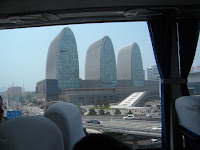 |
| Parabolic buildings Paul & I enjoyed |

Just a few thoughts about driving around Beijing --
juxtaposition was the word that kept coming to mind over and over again. I love the word anyway, and I can't help but compare and contrast things in life even when I shouldn't. Vastly different environments, architecture, and technology were positioned side by side through all three cities we visited, always showing ancient and modern, wealthy and impoverished simultaneously. For instance, we might pass a set of dilapidated apartment buildings or homes, with roofs falling apart, trash and large junk items littering the ground, yet stable, clean apartments stood tall behind them merely a block away. Also, the ceaseless landscaping along the highways was beautiful and immaculately cared for.
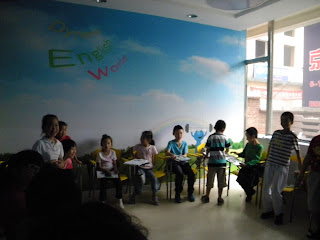
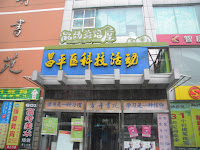
Our first stop on the day's excursion was a private school that specialized in English classes; students there ranged in age and ability, and the courses offered were supplemental ones paid for by the parents. The five of us began in a class with students around six years old, and we played Simon Says with them in English. They thought we were hilarious, and their energy was contagious. One teacher we spoke to said he learned English from his German friend; later I asked Yoko about teacher prep education, and she said private schools are like ours in that they do not require formal teacher education. Public high school teachers, though, must have a master's degree.
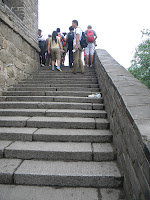
Next, we drove north of the city to the Great Wall at Badaling. The Great Wall goes on and on for thousands of miles; this is just one place to see the Wall. I knew we'd have two hours to spend on the Wall, and I interpreted that as, "Walk up some stairs, walk back and forth on a section of the wall that's perhaps a few city blocks long, walk back down the stairs." I was completely incorrect.
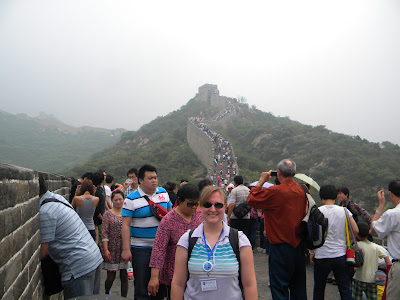
We did walk up some stairs -- several meters off the ground -- but then our goal was to walk all the way to the Eighth Tower, the highest point on this section of the wall, and back in our two hour span. Paul and I took off together, shoulder to shoulder with countless other hikers -- I wouldn't call us visitors or tourists -- as we headed north along the Great Wall of China.
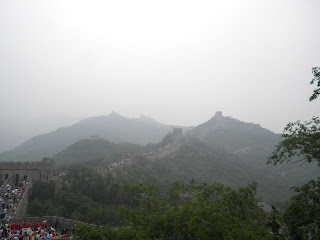
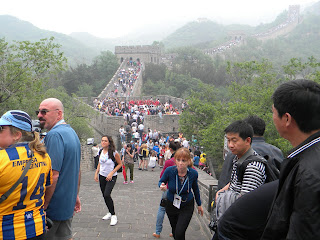
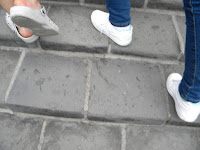
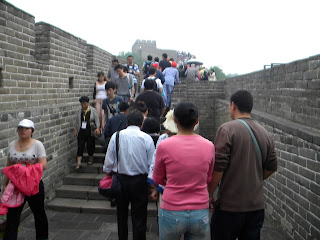
The crowd was thick, and it moved us along at a pretty brisk pace. If I stopped, the crowd moved around me like river water around a rock. Many spans of the Wall were very steep, either stairs or slopes, both up and down as it followed the contour of the mountains. I desperately held onto the handrails along the side to offset my innate lack of balance and depth perception. The height of the steps were never consistent, and I had to pay very close attention to my footing to avoid falling. When people chose to stop and sit on the stairs to rest, though, I had to carefully let go, merge into the flow of traffic as we moved around the group, and then scramble to take hold again. People of all ages and nationalities were walking; people were everywhere. Paul and I defined personal space there as "the space I want to be in," regardless of who else might be currently occupying that space, and I had to leave my Midwestern apologies for bumping into someone back at the entrance gate. I think most hikers planned to spend their entire day there; many were stopping in this alcove or that corner to eat the lunch they packed. Several times I saw people munching on cucumbers -- whole, unpeeled cucumbers, taking a bite out of them as if they were candy bars. I don't know why that image struck me as so unusual, but it did nonetheless, and the thought of it still makes me chuckle to myself.
 |
| Inside a Guard Tower |

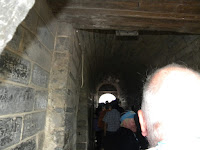
Every now and then, we passed through a guard or watch tower. When the Wall was used by the military for protection, the guards lived in these buildings. Now, most contained public toilets.
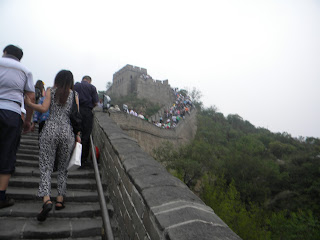
The weather that day was misty and foggy, and it had been rather foggy
the day before at the Palace and Temple. As the day wore on, though, and
the temperature rose well above 80 degrees, the fog never did burn off.
I have a feeling that fog was really the smog we stereotypically think
of when we consider China. It made for some very interesting photos,
though.
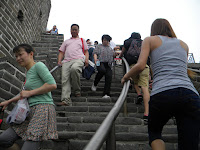 |
| The steepest climb we conquered |
 |
| Paul, getting a little punchy |
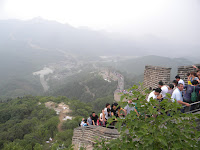 |
| Looking back at the steepest section |
 |
| Frontage Road |
 |
| Our Deciding Point: The Eighth Tower from our furthest destination |
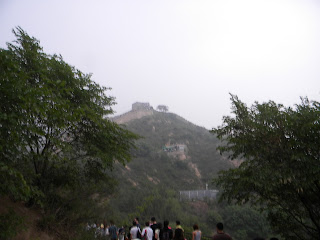
After walking for an hour and fifteen minutes, Paul and I needed to make
a decision. We were hot, sweaty, getting rather tired and sore, and we
had only forty-five minutes to reach the Eighth Tower
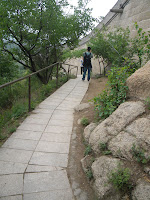
and travel back to the meeting place for lunch in the government-owned store and museum. We decided on two mottoes: "Know thyself" and "Nothing in excess." We knew that we weren't going to make it up to the tower and back in that time, and we should begin our descent. As we made this decision, we happened to be next to the Wall instead of on it, and we discovered we could take a path akin to a frontage road back down for quite some time. I really enjoyed walking there; the traffic was minimal, the incline was flatter, and the stone sidewalk was much more consistent. As we walked, a group of three young Chinese adults stopped Paul and asked if they could take their picture with him. He thinks he appeared to be a "cultural relic."
 |
| The Sliding Car Station |
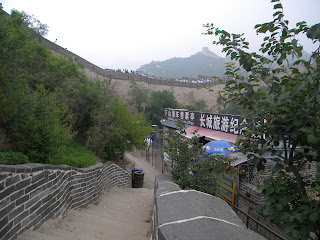
Soon we reached a station for a Sliding Car -- something that looked like a simple roller coaster car that takes passengers back down to the parking lots, shops, and restaurants. It cost 30 yuan, or $5, to ride. Paul and I deliberated, but not for long. We quickly dug out our money and walked through the empty line ropes to the two women who were standing at the gate. We held our money out to them, expecting our ticket in return, but instead they looked frustrated with us. They must deal with crazy tourists who don't know the process all the time. They shook their heads, said something in Chinese, pointed at the sign in Chinese, pointed to the path that took us back to the Wall, and shook their heads again. We repeated this process two, maybe three more times. So, Paul and I sadly put our money away and started to trek back down, this time back up on the Wall. Going down was much easier than going up, perhaps, as Paul said, because gravity was helping. (That certainly wasn't true along the Camino in hilly France, so I was rather surprised.) At the time, no signs told us how far we traveled that day, and even in my very informal research online, it took quite a while to find out the distance from the entrance gate to the Eighth Tower. I was shocked to find one
site says it is only 0.9 miles to the Eighth tower, which means we didn't even walk that far one-way. However, the same site says the incline was 748 feet, which explains why it was so difficult to climb amid all the other hikers. It took us only 40 minutes to return to our group's meeting place, so we were able to spend 5 minutes or so meandering through the store before lunch. There you could buy a life-size statue of a Terra Cotta Warrior, silk embroidered rugs that were at least $2,000, jewelry far beyond my price range, and trinkets, lots and lots of trinkets. After lunch, I bought a handful of gifts and souvenirs there.
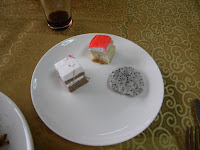
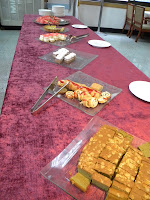
Lunch was set up as a buffet, and food was similar to what we'd had thus far. Different types of meat and/or vegetables in different types of sauces, rice, makings for a fresh salad, even Italian vegetable soup. I didn't get a snapshot of all of the main dishes available, but I did get one of the desserts -- which look just like the ones served in American Chinese buffets! I was excited to know that they do indeed have something authentic besides rice, because nothing else had looked remotely familiar. With dessert, I also tried what I found to be dragon fruit -- the clearish fruit on my plate, with all the seeds. Dragon fruit has no flavor, whatsoever. None. It's like chewing nothing; it has less flavor than water. Yoko told us it has many nutrients, so at least there's a positive characteristic.
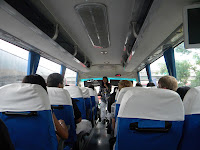 |
| Yoko, our tour director, telling us about Chinese culture and history |
 |
| The Bird's Nest |
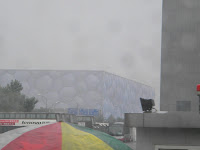
As we drove back to the city, the skies opened, and it rained the entire hour drive. As we pulled into the 2008 Olympic
neighborhood, though, the rain slowed down while we drove by the Water
Cube, where Michael Phelps won his gold medals. Thankfully, it stopped
just as we got off the bus to see the Bird's Nest Stadium.
 |
| The Water Cube |
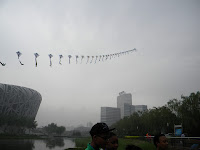 |
| A single kite, being sold by local vendors |

We finished our afternoon with a tea ceremony and demonstration at a Tea
House.
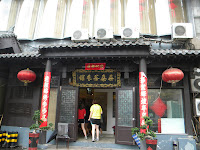 |
| The Tea House |
 |
| Jasmine tea brewing, opening up |

The presenter told us about five different types of tea -- black
and green, black with roses, jasmine, long-term black, and fruit. The
team of ladies served each of us a small teacup of each, and we learned
how to smell the tea (in the taller cup) to determine its quality. None
of the tea was brewed in a teabag; for each kind, boiling water was
poured over the tea leaves and that was all. The jasmine tea could be
brewed from a ball of tea leaves and flower petals that opened up into a
beautiful display that could be kept on a shelf for days. They showed
us an awesome tea cup that changes colors and designs when hot water is
poured into it; I bought one that says, "Giant Panda," in Chinese
characters and changes into a drawing of a few pandas. They also showed
us a small clay statue they called the Pee Pee Boy, which is used to determine if your boiling water is hot enough to
make tea. It's stored in cold water, and when you pour water that is hot
enough over him, he "pees." It was fun to laugh about it with the kids,
and everyone received one with a purchase.
Dinner that night was at a restaurant that is famous for its Peking Duck dish and has been serving it since approximately 1416. Peking was the original name of Beijing, and the city made this dish famous.
The meal was served lazy susan style, and we had several other dishes to share, including rice, tomatoes, potatoes, noodles, tofu with vegetables in a sauce, and fried dough that tasted a lot like an elephant ear at our county fairs.
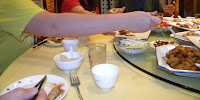
The duck was roasted and sliced into very small pieces; we picked up a slice, dipped it in a dish of dark brown sauce, and put it in something like a crepe or egg roll paper. We could then add bean sprouts and slices of cucumber (cut long-ways down the cucumber, not sliced in disks as we often do) in the wrap. The waiting staff showed us how to place one chopstick inside the crepe and another outside to twist it into a tight little wrap. It was absolutely delicious!


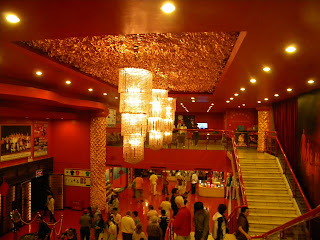
We finished our day with a theatrical show at the Red Theater about Kung Fu. The show used song and dance to tell the story of a young monk who learned kung fu and used it to live his life well. A large portion of the lyrics were in English, and those that were not were translated on a screen above the stage. Throughout the show, kung fu masters displayed their strength, determination, and ability to use their minds to avoid bodily harm. I thoroughly enjoyed the show, especially when people in the traditional Chinese dragon costumes joined the cast at the end of the show.
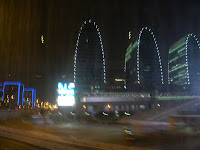 |
| A night-view of the parabolic buildings |


 Just a few thoughts about driving around Beijing -- juxtaposition was the word that kept coming to mind over and over again. I love the word anyway, and I can't help but compare and contrast things in life even when I shouldn't. Vastly different environments, architecture, and technology were positioned side by side through all three cities we visited, always showing ancient and modern, wealthy and impoverished simultaneously. For instance, we might pass a set of dilapidated apartment buildings or homes, with roofs falling apart, trash and large junk items littering the ground, yet stable, clean apartments stood tall behind them merely a block away. Also, the ceaseless landscaping along the highways was beautiful and immaculately cared for.
 Our first stop on the day's excursion was a private school that specialized in English classes; students there ranged in age and ability, and the courses offered were supplemental ones paid for by the parents. The five of us began in a class with students around six years old, and we played Simon Says with them in English. They thought we were hilarious, and their energy was contagious. One teacher we spoke to said he learned English from his German friend; later I asked Yoko about teacher prep education, and she said private schools are like ours in that they do not require formal teacher education. Public high school teachers, though, must have a master's degree.
  Next, we drove north of the city to the Great Wall at Badaling. The Great Wall goes on and on for thousands of miles; this is just one place to see the Wall. I knew we'd have two hours to spend on the Wall, and I interpreted that as, "Walk up some stairs, walk back and forth on a section of the wall that's perhaps a few city blocks long, walk back down the stairs." I was completely incorrect.


 The crowd was thick, and it moved us along at a pretty brisk pace. If I stopped, the crowd moved around me like river water around a rock. Many spans of the Wall were very steep, either stairs or slopes, both up and down as it followed the contour of the mountains. I desperately held onto the handrails along the side to offset my innate lack of balance and depth perception. The height of the steps were never consistent, and I had to pay very close attention to my footing to avoid falling. When people chose to stop and sit on the stairs to rest, though, I had to carefully let go, merge into the flow of traffic as we moved around the group, and then scramble to take hold again. People of all ages and nationalities were walking; people were everywhere. Paul and I defined personal space there as "the space I want to be in," regardless of who else might be currently occupying that space, and I had to leave my Midwestern apologies for bumping into someone back at the entrance gate. I think most hikers planned to spend their entire day there; many were stopping in this alcove or that corner to eat the lunch they packed. Several times I saw people munching on cucumbers -- whole, unpeeled cucumbers, taking a bite out of them as if they were candy bars. I don't know why that image struck me as so unusual, but it did nonetheless, and the thought of it still makes me chuckle to myself.

 Every now and then, we passed through a guard or watch tower. When the Wall was used by the military for protection, the guards lived in these buildings. Now, most contained public toilets.
  The weather that day was misty and foggy, and it had been rather foggy
the day before at the Palace and Temple. As the day wore on, though, and
the temperature rose well above 80 degrees, the fog never did burn off.
I have a feeling that fog was really the smog we stereotypically think
of when we consider China. It made for some very interesting photos,
though.
The weather that day was misty and foggy, and it had been rather foggy
the day before at the Palace and Temple. As the day wore on, though, and
the temperature rose well above 80 degrees, the fog never did burn off.
I have a feeling that fog was really the smog we stereotypically think
of when we consider China. It made for some very interesting photos,
though.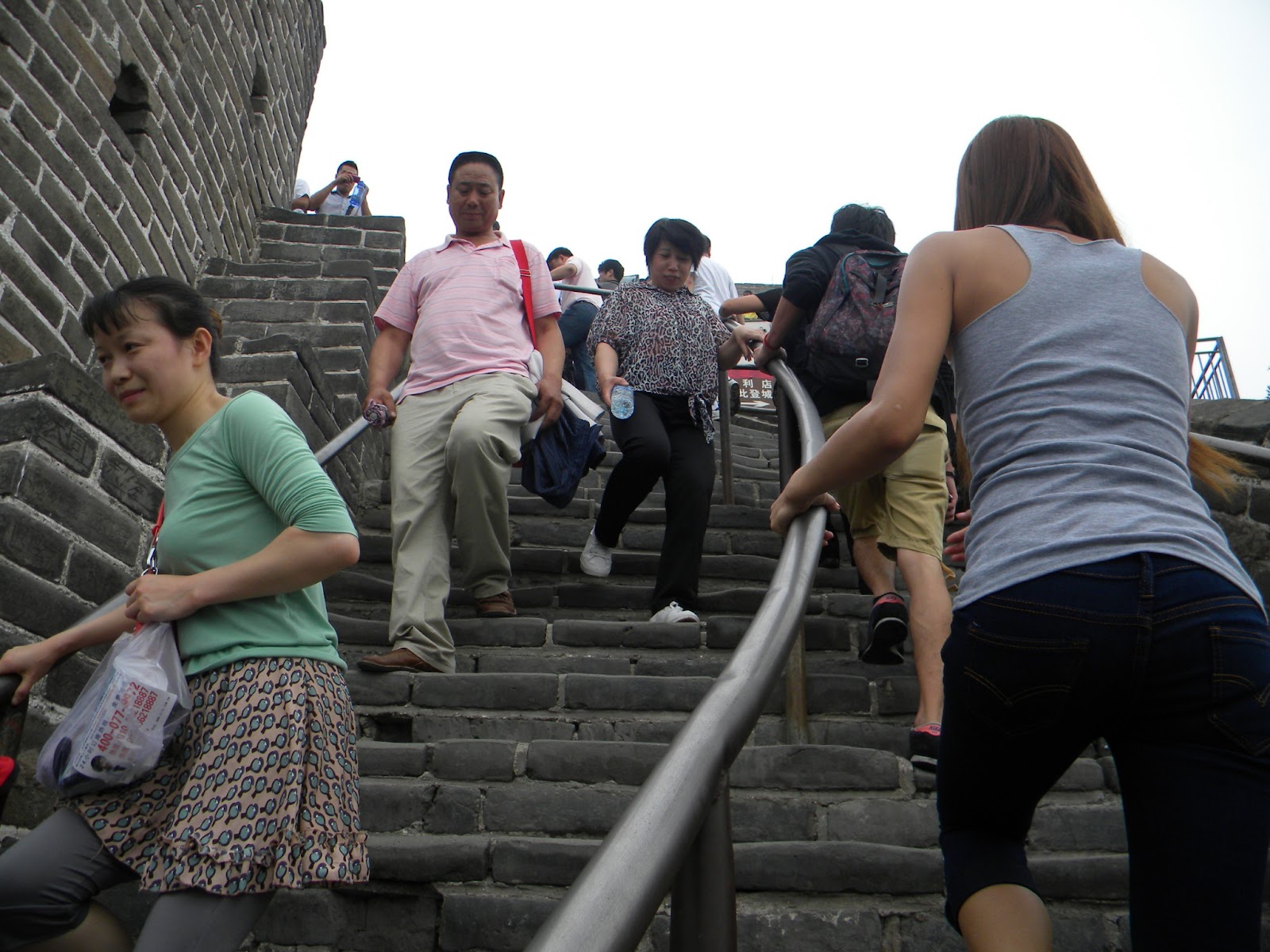


 Lunch was set up as a buffet, and food was similar to what we'd had thus far. Different types of meat and/or vegetables in different types of sauces, rice, makings for a fresh salad, even Italian vegetable soup. I didn't get a snapshot of all of the main dishes available, but I did get one of the desserts -- which look just like the ones served in American Chinese buffets! I was excited to know that they do indeed have something authentic besides rice, because nothing else had looked remotely familiar. With dessert, I also tried what I found to be dragon fruit -- the clearish fruit on my plate, with all the seeds. Dragon fruit has no flavor, whatsoever. None. It's like chewing nothing; it has less flavor than water. Yoko told us it has many nutrients, so at least there's a positive characteristic.


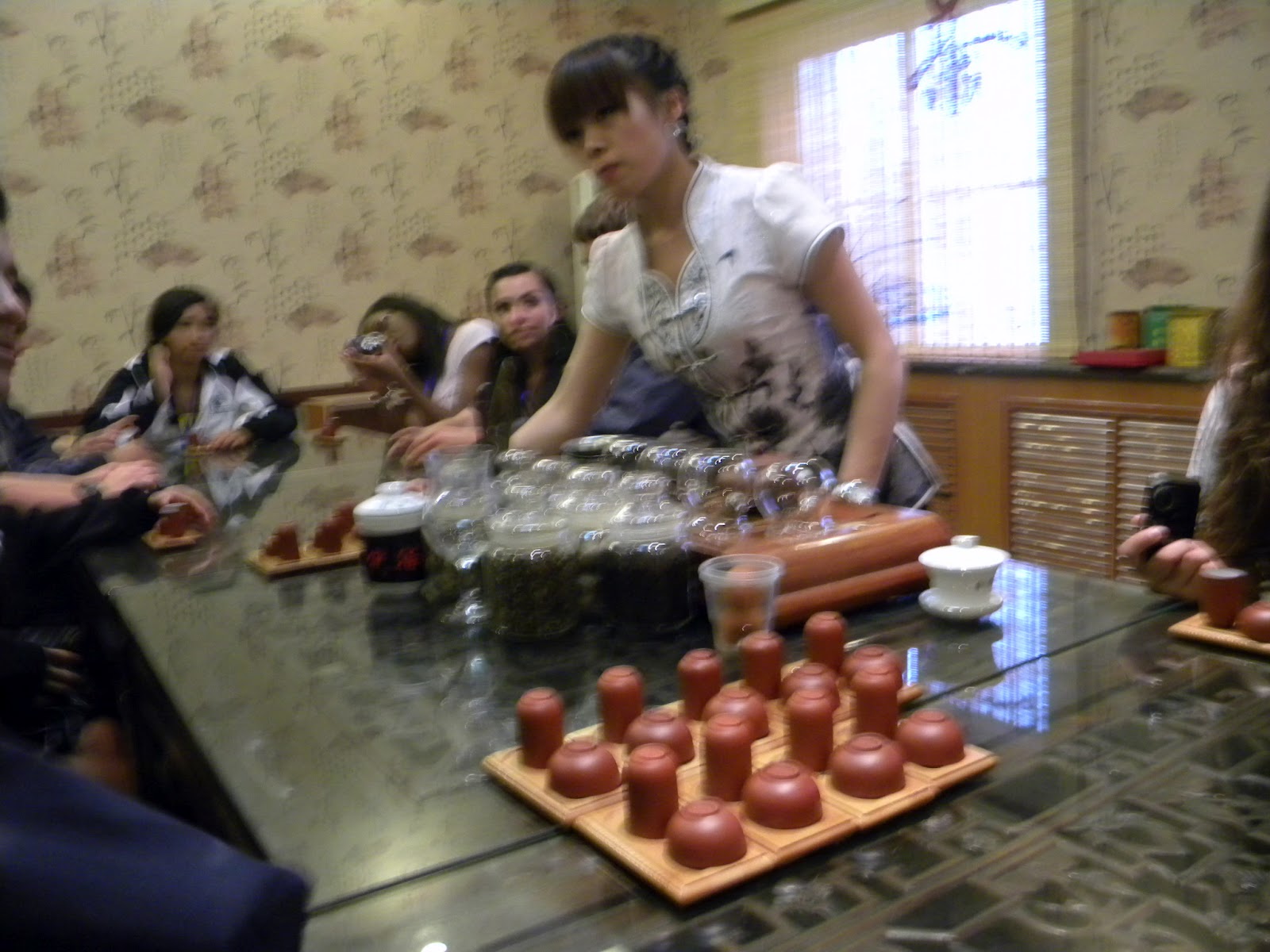 The presenter told us about five different types of tea -- black
and green, black with roses, jasmine, long-term black, and fruit. The
team of ladies served each of us a small teacup of each, and we learned
how to smell the tea (in the taller cup) to determine its quality. None
of the tea was brewed in a teabag; for each kind, boiling water was
poured over the tea leaves and that was all. The jasmine tea could be
brewed from a ball of tea leaves and flower petals that opened up into a
beautiful display that could be kept on a shelf for days. They showed
us an awesome tea cup that changes colors and designs when hot water is
poured into it; I bought one that says, "Giant Panda," in Chinese
characters and changes into a drawing of a few pandas. They also showed
us a small clay statue they called the Pee Pee Boy, which is used to determine if your boiling water is hot enough to
make tea. It's stored in cold water, and when you pour water that is hot
enough over him, he "pees." It was fun to laugh about it with the kids,
and everyone received one with a purchase.
The presenter told us about five different types of tea -- black
and green, black with roses, jasmine, long-term black, and fruit. The
team of ladies served each of us a small teacup of each, and we learned
how to smell the tea (in the taller cup) to determine its quality. None
of the tea was brewed in a teabag; for each kind, boiling water was
poured over the tea leaves and that was all. The jasmine tea could be
brewed from a ball of tea leaves and flower petals that opened up into a
beautiful display that could be kept on a shelf for days. They showed
us an awesome tea cup that changes colors and designs when hot water is
poured into it; I bought one that says, "Giant Panda," in Chinese
characters and changes into a drawing of a few pandas. They also showed
us a small clay statue they called the Pee Pee Boy, which is used to determine if your boiling water is hot enough to
make tea. It's stored in cold water, and when you pour water that is hot
enough over him, he "pees." It was fun to laugh about it with the kids,
and everyone received one with a purchase.
 The duck was roasted and sliced into very small pieces; we picked up a slice, dipped it in a dish of dark brown sauce, and put it in something like a crepe or egg roll paper. We could then add bean sprouts and slices of cucumber (cut long-ways down the cucumber, not sliced in disks as we often do) in the wrap. The waiting staff showed us how to place one chopstick inside the crepe and another outside to twist it into a tight little wrap. It was absolutely delicious!

 We finished our day with a theatrical show at the Red Theater about Kung Fu. The show used song and dance to tell the story of a young monk who learned kung fu and used it to live his life well. A large portion of the lyrics were in English, and those that were not were translated on a screen above the stage. Throughout the show, kung fu masters displayed their strength, determination, and ability to use their minds to avoid bodily harm. I thoroughly enjoyed the show, especially when people in the traditional Chinese dragon costumes joined the cast at the end of the show.


